

Commissioning robotic installation in the United States
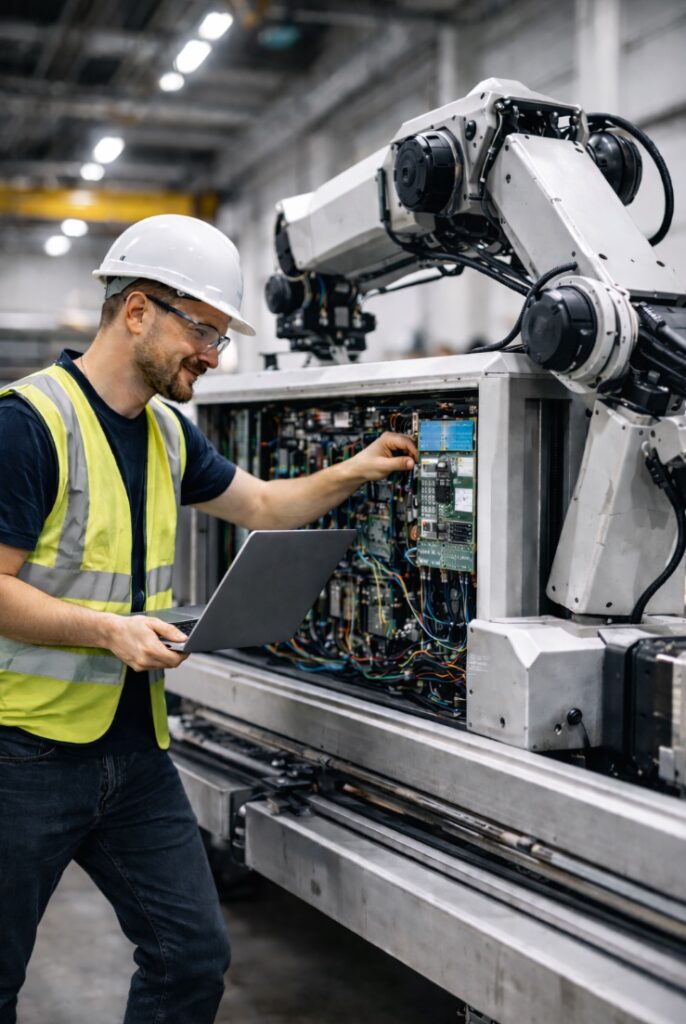
At TRIBE Engineering, we regularly work on international projects where technology and collaboration come together. For a project in the USA, our engineers supported the commissioning of an advanced robotic installation. The goal of this trajectory was to further automate an existing research process and contribute to a stable and controlled work environment.
From manual processes to automated research
In modern research environments, precision is super important. For an international research facility, a robot was deployed to take over a portion of the manual tasks. Where measurements and inspections were previously performed by hand, the system now supports an automated process within a controlled environment. This contributes to consistent research conditions and reliable results.
Careful preparation as the starting point
The project began in the Netherlands, where the robotic installation was carefully prepared for transport. As this concerned a custom-built setup with various technical expansions, a detailed approach was essential. Since the system had to be reassembled in sections on-site, our engineers meticulously documented all components, cabling, and settings. This preparation formed the foundation for an efficient project execution in the USA.
For TRIBE. Engineering, our strength lies in thinking through scenarios in advance. This includes not only how an installation is built, but also how it should be dismantled, what might go wrong during transport, and how local conditions impact reinstallation. By addressing these questions early on, we create a stable environment for execution and room for effective on-site collaboration.
On-site collaboration
Two months later, we flew to the US. There, we faced an additional challenge: due to local regulations, we were not permitted to perform any physical assembly ourselves. Instead, we were put in charge of three local teams: a mechanical team, an electrical team, and a heavy-lift transport team.
The two of us managed these groups. It is quite a challenge to explain the wiring of a complex robot to electricians without prior experience in machine building. Fortunately, technicians all over the world speak the same language. After a lot of careful positioning and adjustment, the frame was in place, and the first electrical connections could be made.
From tornado warnings to a fully operational system
Working in the USA also means accounting for local surprises. While configuring the safety zones, a loud alarm suddenly echoed throughout the building. It wasn't a technical fault, but a tornado warning! After a brief stay in the storm shelter, we were fortunately able to quickly get back to what we do best: engineering.
In the third week, we realized the integration with the existing system. Thanks to thorough preparation and extensive on-site troubleshooting, we successfully linked the legacy system to the new robot. All safety systems and the high-speed doors separating the climate zones eventually worked together seamlessly.
Proud of the result
After three weeks of hard work, we handed the project over to the software engineers for the final camera integration. For TRIBE. Engineering, this project had it all: technical complexity, logistical challenges, and international management.
We look back on a successful collaboration and a magnificent installation in the USA that we, as a company, can be truly proud of!