
No room for doubt in offshore deployment
Offshore operations take place in an environment with limited access, fixed procedures, and a direct dependency on the onboard team. Helicopter transport and stays on installations involve specific risks not found in onshore situations. To be prepared for this, BOSIET is a mandatory requirement for personnel deployed offshore.
Within technical projects, such as commissioning and service operations, this means that engineers must not only master their trade but also be familiar with the site's safety structure. This combination determines how effectively work is performed under offshore conditions.
Training modules and scenarios
The BOSIET training focuses on recognizable emergency situations and the correct execution of procedures. The content is structured around situations that may occur during transport and offshore stays.
Key components include:
- Firefighting and evacuation: Exercises in locating and controlling fire hazards and following evacuation procedures.
- Sea survival: Training in the use of life-saving equipment and the organization of group behavior in the water.
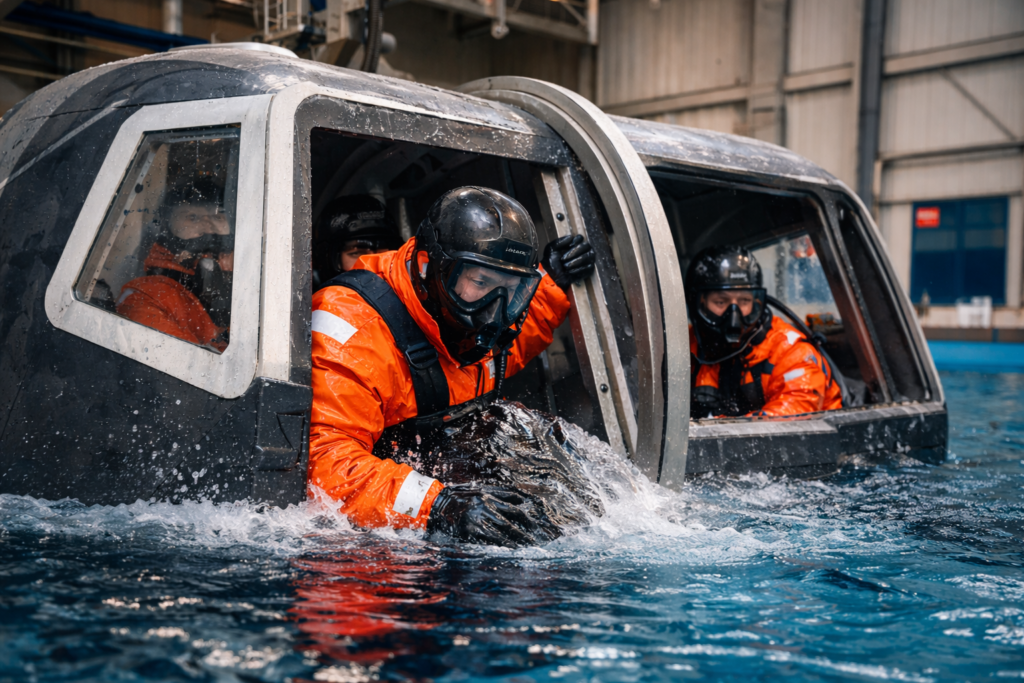
- Helicopter Underwater Escape Training: Practical exercises focused on escaping a submerged helicopter.
The emphasis is on execution. Actions are repeated until they can be performed consistently under pressure.
Operational response in emergency situations
During offshore operations, response times during incidents are limited, and external support is not immediately available. In such situations, every action must be predictable. BOSIET ensures that team members apply the same principles and understand how to operate within established procedures.
This prevents differences in interpretation and ensures a consistent way of working, even when teams consist of various disciplines or nationalities. Safe operation is thus a shared responsibility rather than an individual assessment.
Ensuring compliance within project preparation
Within TRIBE Engineering, BOSIET is an integral part of the preparation for offshore deployment. Engineers are deployed based on their technical roles and possess the required certifications for the work area.
The training is directly linked to the practical requirements of the project. Clear agreements on working methods and safety frameworks ensure consistent execution on-site, in coordination with other involved parties.
Offshore operations demand unambiguous action under conditions where there is little room for interpretation. Within TRIBE, this foundation is considered an essential part of professional conduct, where preparation and execution are seamlessly aligned.