
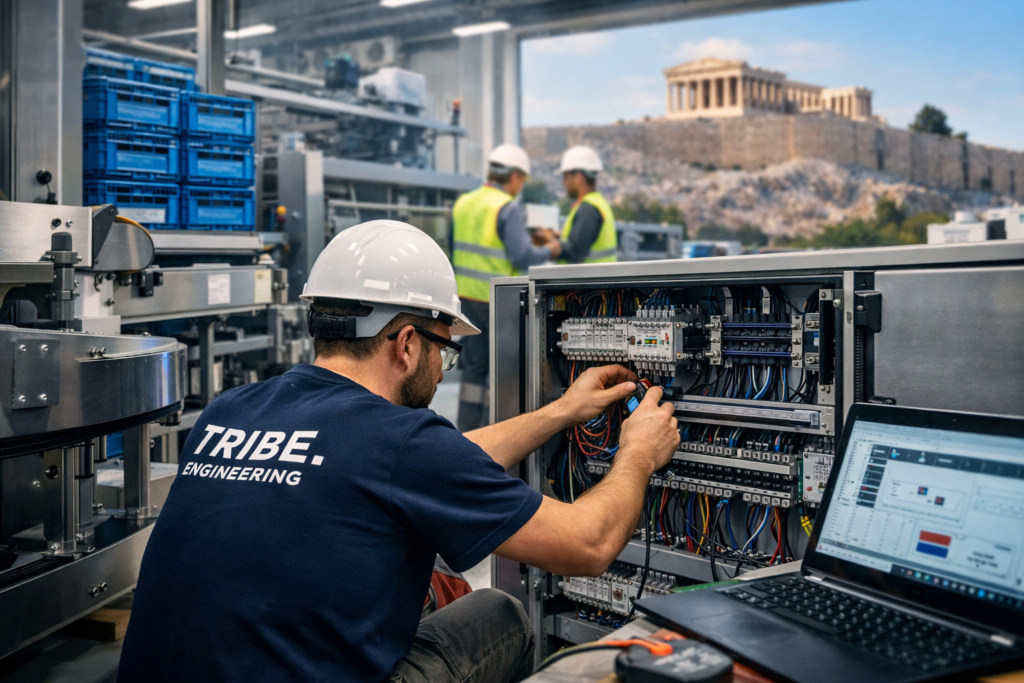
International collaboration and electrical commissioning of a new production line
Sometimes a project is about more than just delivery. It is about understanding, improving, and looking ahead. For one of our engineers, this involved traveling to Greece to assist with the installation of a completely new production line, a so-called greenfield installation.
A greenfield project offers unique opportunities. Because the installation is built entirely from scratch, there is room to understand the system from start to finish. This ranges from mechanical assembly to electrical connection, and from initial testing to fault analysis.
The system in practice
The installation forms the initial stage of a processing line. Products arrive in stacked crates, which are automatically destacked within the system. The product then undergoes an initial processing step before moving further down the line.
The back end of the process has also been carefully considered. Empty crates are cleaned, restacked, and prepared for reuse. This results in a fully closed and efficient system where logistics and process engineering converge.
Focus on electrical engineering and commissioning
Within this project, the focus was primarily on the first section of the line. Our engineer was responsible for pulling and connecting cabling, both to the motors and within the control cabinets. This is an essential component, as a stable installation starts with a correct electrical foundation.
In addition to the installation work, efforts were focused on the initial system startup. As is often the case with new installations, this was not a straightforward process. Errors in previous connections and some software-related issues meant that the system was not yet fully operational.
This phase is precisely where the value lies. By analyzing faults and getting systems operational step by step, a deep understanding of the installation is developed. This insight is directly applied to future optimizations and the further development of similar installations.
Learning with a view to the future
The project was not only operational in nature but was also focused on building knowledge. By actively participating in construction and analysis, the exact combination of practical experience and system knowledge is developed that is necessary to successfully lead future conversion projects.
The transition from the current installation to a next, optimized generation requires more than just technical knowledge; it also demands insight into how the system behaves in practice. This project provided a strong foundation for that.
Collaboration as the key
A project like this is never a solo effort. In collaboration with international teams, work was carried out on the realization and initial commissioning of the line. Despite the challenges, the project was successfully completed, with appreciation for the commitment and collaboration shown.
And that is exactly what it is all about. Building together, solving together, and taking that next step together, every time.